How do massive quiescent galaxies form in the early Universe?
Massive quiescent galaxies are already in place just a few billion years after the Big Bang, but their formation pathways remain poorly understood.
Dusty star-forming galaxies (DSFGs) have long been considered key progenitors, yet the physical connection between these populations is still unclear.
Using JWST spectroscopy, this work explores whether DSFGs truly represent a transitional phase toward quiescence, or a more complex stage in galaxy evolution.
- Reduced and stitched JWST/NIRSpec multi-grating spectra (G140M/G235M/G395M) with continuum-based polynomial scaling and inverse-variance-weighted merging.
- Classified 249 galaxies at z = 2–6 into star-forming, green valley, and quiescent populations via Hα equivalent width.
- Identified 24 dusty star-forming galaxies (DSFGs) using AV > 1, cross-validated against the rest-frame UVJ diagram and Hα equivalent width.
- Performed Bayesian SED fitting with Prospector using 14-bin nonparametric star formation histories, simultaneously fitting NIRSpec R~1000 spectra and 12-band NIRCam photometry.
- Quantified dynamical states and star formation activity using σsmooth, SFR10/SFR100, quenching velocity (vquench), and peak SFR.
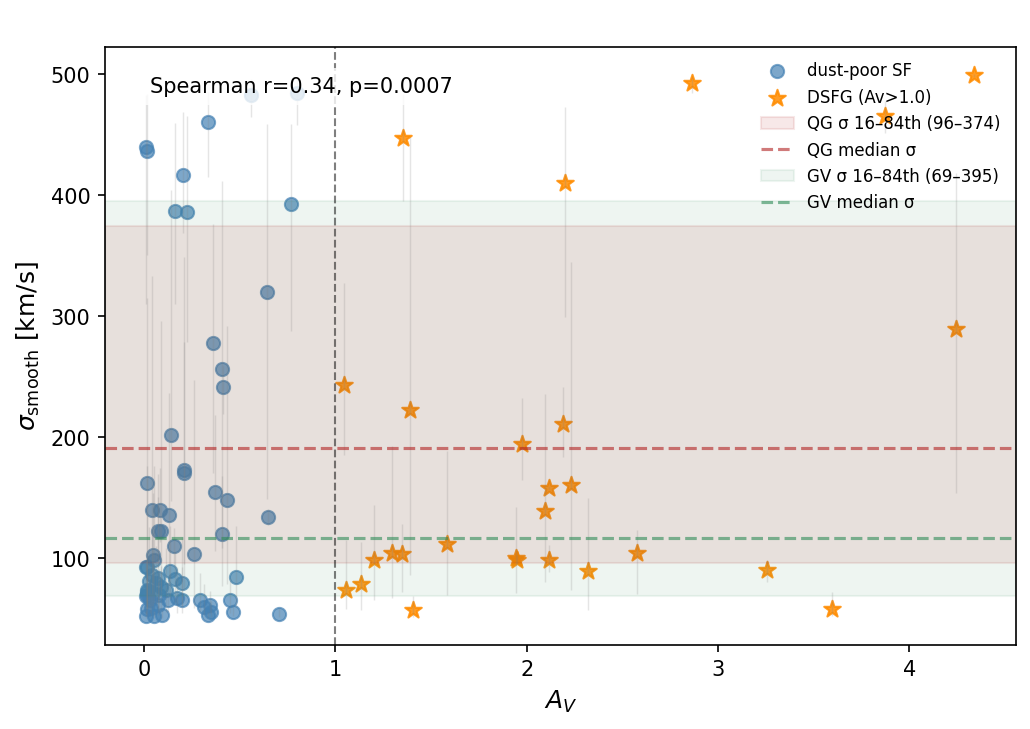
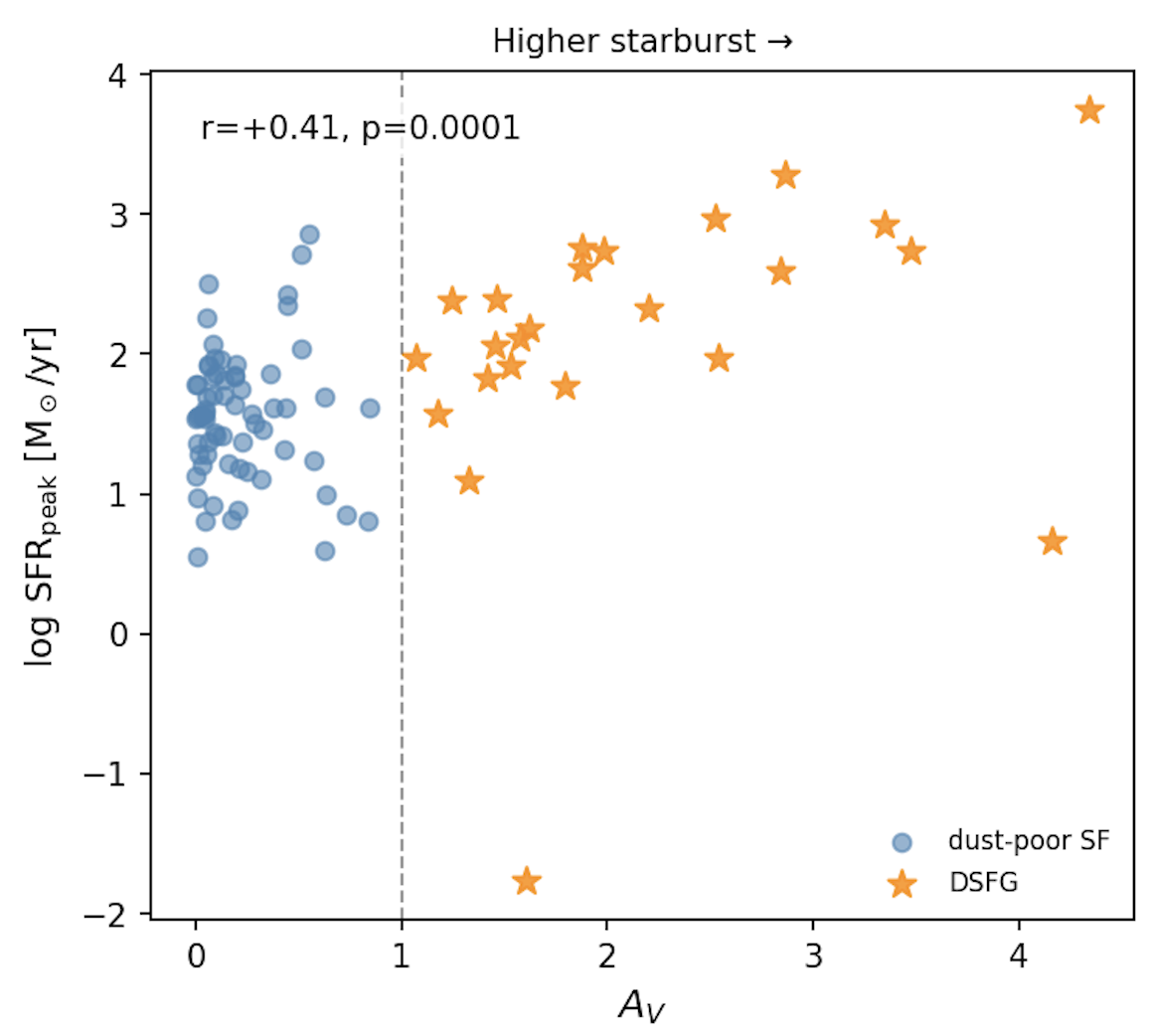
DSFGs are dynamically hotter than dust-poor star-forming galaxies (median σsmooth 111 vs. 87 km/s, p = 0.021) yet statistically indistinguishable from green valley galaxies, suggesting they already occupy a dynamically mature regime. They are uniquely characterized by positive SFR10/SFR100 ratios (median R = +0.185), indicating active starburst phases not seen in any other population. A moderate positive correlation between AV and SFRpeak (Spearman r = 0.41) further links dust buildup to intense past star formation. Among high-redshift DSFGs (z > 3), two systems show extreme quenching velocities (vquench > 19 dex/Gyr), representing ~8% of the full DSFG sample and highlighting a viable evolutionary pathway toward massive quiescent galaxies.